




Here you can discover the ways of supporting the work of Just Reinvest NSW and to reduce Aboriginal People’s contact with the criminal justice system.
get involved / community member
Take action - find out how JR could help your community
Donate
Work with us
Partnership
Internships
Follow us and share
Contact us
JRNSW pathway to change
The JRNSW Pathway to Change provides a “blueprint” for Aboriginal communities to understand the different phases of engaging in a justice reinvestment approach to overincarceration. Supported all the way through the process there are five stages in which a community must succeed in implementing if they are to see true change and transformation. There are also four stages in which JRNSW can support communities through a process of ongoing learning through data measurement and evaluation; and support in setting up the necessary structures to implement JR strategies.
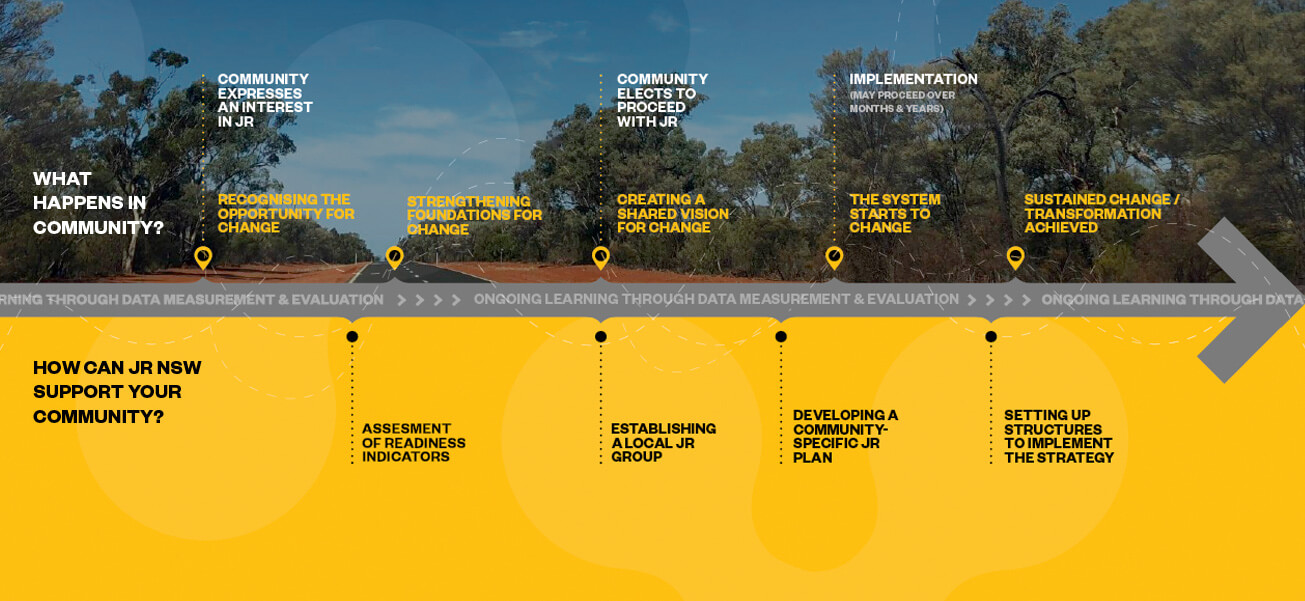
 Download
JRNSW Pathway to change
justice reinvestment
explained
Watch the following videos to see how justice reinvestment works to bring systemic changes that can build safer and stronger communities. The justice reinvestment approach in Aboriginal communities can help build on self-determination and support place-based, community-led and data driven approaches to inform local solutions to overincarceration, such as devising local ‘justice circuit-breakers’.
Why do we need community-led solutions to aboriginal over imprisonment?

Watch this video to learn why we need community-led solutions to Aboriginal overimprisonment. Aboriginal communities have the solutions because they have a right to self-determination: the right to shape their own lives. Aboriginal communities want data sovereignty, meaning access to data about them in relation to people, to country, to land, to waters, to stories, to culture, to connection and in relation to resources. When an Aboriginal community determines what is measured and why, they are empowered to collect their stories, and a way to speak their truth and advocate for solutions
what is a justice reinvestment mechanism and how does it work?

This video explains that a ‘reinvestment mechanism’ is a government financing mechanism that makes financial resources available to communities for justice reinvestment. This means governments may pay a levy or monies from a fund to communities that is calculated based on the number of Aboriginal people incarcerated in NSW. The resources generated are then spent in areas where Aboriginal communities determine needs more support, and on what will be felt by those most impacted.
How do you measure the cost-benefit of a justice reinvestment mechanism?

This video explains how the cost of doing ‘business as usual’ in justice responses that result in high rates of incarceration, will continue to exacerbate social drivers of offending, such as homelessness and poor health. We know this can lead to a cycle that undermines and dismantles cohesion in our communities. Evidence points to early intervention and prevention successfully addressing the drivers of offending. A justice reinvestment approach will deliver benefits in community and should therefore form part of any cost-benefit analysis. Upfront financial commitments in justice reinvestment saves the government money; and it ‘makes’ money as the number of Aboriginal prisoners reduces.
downloads
History and concept of JR

Read about where the concept of Justice Reinvestment came from and how it was adopted by Indigenous communities in Australia.
 Download
History and concept of JR
Data links and the
data locator tool

All the publicly available data links relevant to Aboriginal communities in New South Wales can be found here at the Data Hub..
Download
JRNSW PPT Template
The average daily number of Aboriginal adult prisoners in NSW increased by 36.4% in the last decade (3524)
Active JRNSW Communities
The communities who are already engaged with Justice Reinvestment initiatives and pilot programs.
There are four Aboriginal communities across New South Wales who are currently working with their communities on their justice reinvestment strategies. JR NSW is also a member of the Justice Reinvestment Network of Australia (JRNA), which provides organisations and communities in other States and Territories who are already involved in JR initiatives an opportunity to coordinate and share their experiences across policy platforms.

Justice Reinvestment Network Australia (JRNA)
JR NSW is also a member of the Justice Reinvestment Network of Australia (JRNA)
Find out more

Kempsey ‘Learning the Macleay’
Working alongside ‘Learning the Macleay’ on systems change
Find out more